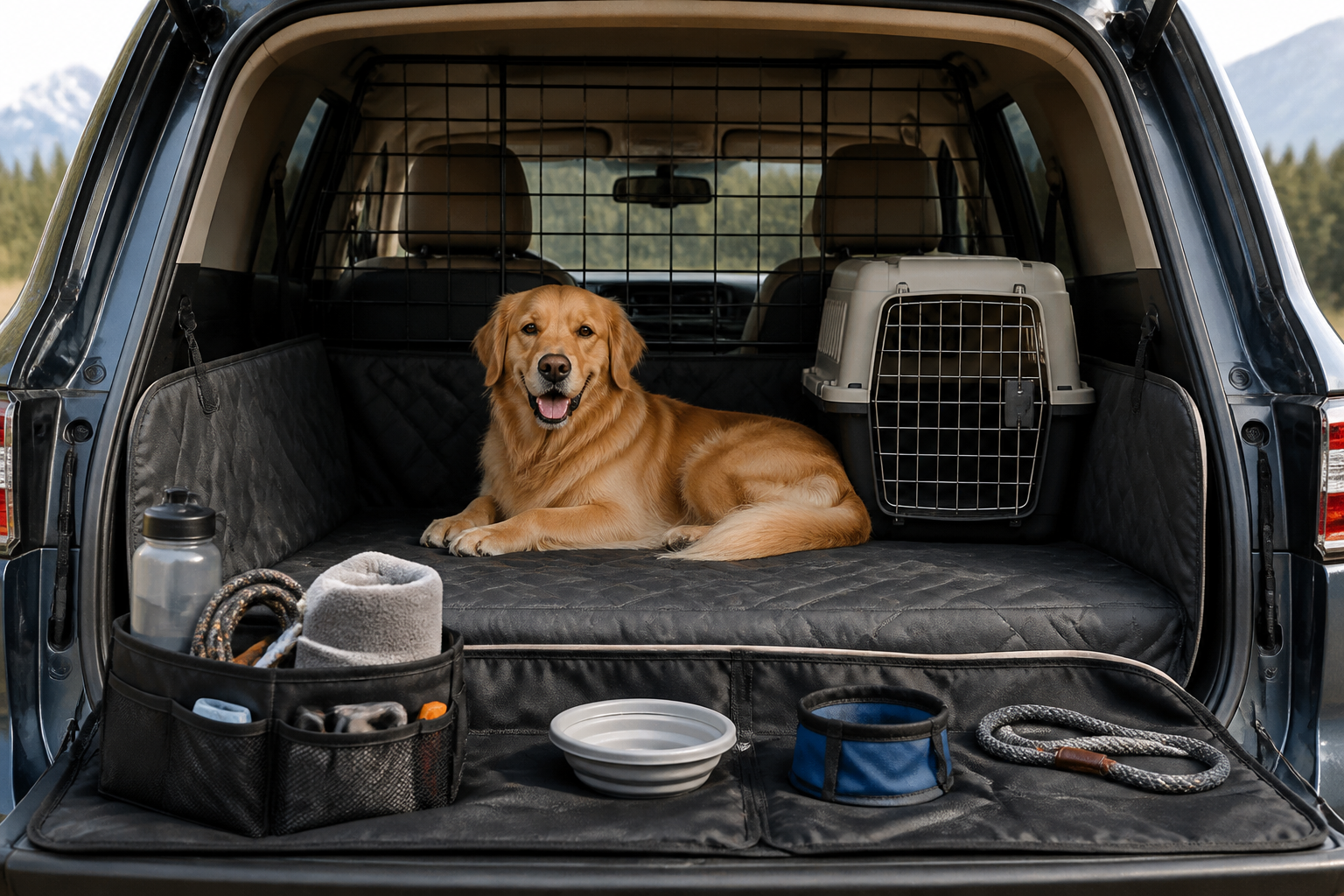
A useful dog travel setup is not a random collection of accessories. It is a system in which each item has a separate job: keeping the dog in an appropriate riding space, reducing driver distraction, protecting the interior, making water and cleanup manageable at stops, and preventing loose supplies from rolling through the vehicle.
The shopping order matters. A seat cover, cargo barrier, and organizer can make travel cleaner and less chaotic, but they are not substitutes for a properly used restraint, carrier, or secured crate. CDC guidance advises placing a dog riding on a seat in the back seat with a harness attached to the seat buckle, or using a well-ventilated crate that is secured so it will not slide or shift. Start with how your dog will ride, then choose accessories that support that plan.
Start with the travel problem you need to solve
| Your main problem | First item to prioritize | Helpful supporting gear |
|---|---|---|
| Your dog moves around the vehicle or distracts the driver | An appropriate rear-seat restraint, carrier, or secured travel crate | A barrier for space management and a compact organizer |
| Muddy paws, shedding, wet swims, or occasional accidents | A fitted seat cover or cargo liner with a non-slip underside | A washable blanket and a cleanup pouch |
| Your dog rides in an SUV cargo area | A vehicle-compatible crate if crate travel is your chosen setup | A cargo barrier, cargo liner, and compatible securing straps where specified |
| You take frequent day trips, hikes, and rest stops | A portable water container and collapsible bowl | A small grab-and-go organizer bag |
| You travel with more than one dog | A separate workable riding space for each dog | Washable protection and a divided organizer |
Do not buy an item simply because it is labeled “universal,” “heavy duty,” or “safe.” Those terms do not tell you whether it fits your vehicle, accommodates your dog, or works with the way you load passengers and luggage. Measure first, read the installation instructions before ordering, and make a short test drive part of the purchase process.
1. Choose the riding setup before buying accessories
For many dogs, the practical choice is between a rear-seat vehicle harness and a secured travel crate. The best option depends on your dog’s size and temperament, the vehicle layout, available attachment points, and whether you can follow the product instructions exactly.
When a rear-seat harness may fit your routine
- Your dog rides calmly on the rear bench and is comfortable wearing a harness.
- You need the cargo area for luggage, strollers, groceries, or other gear.
- You want a setup that is usually quicker to remove than a crate.
- Your dog falls within the manufacturer’s stated fit range and the connection is compatible with your vehicle’s seat-belt geometry.
Look beyond the phrase “dog seat belt.” A short tether or clip can help limit wandering, but that is not the same thing as demonstrated crash protection. If a product is marketed for crash protection, look for clear testing information, a stated size range, and specific instructions for the supplied hardware. The Center for Pet Safety publishes a current list of products in its certification program; a certification claim should be checked against that list rather than accepted from packaging language alone.
When a travel crate may fit your routine
- Your dog settles well in a familiar crate.
- You drive an SUV, wagon, or van with enough usable space and appropriate securing points.
- You want a defined decompression or sleeping space at hotels, relatives’ homes, or campsites.
- You can secure the crate without blocking ventilation, hatch access, or the crate door.
Size a crate for ordinary movement rather than excess floor space. CDC and AKC guidance says the dog should be able to stand, turn, and lie down comfortably; the crate should also be ventilated and secured against sliding or shifting. Inspect the interior for protrusions, the door and latch for reliable operation, and the floor for a surface that can be kept clean.
Important: do not assume every crate is designed or tested for crash protection. Ordinary crates can be useful for containment and travel comfort, but containment claims and crash-performance claims are different. The Center for Pet Safety’s published testing and certification materials make this distinction clear. Treat a vague “tested” label as a prompt to investigate, not as proof of performance.
2. Use a car barrier for management, not as the main restraint
A dog car barrier can be very useful in an SUV or hatchback. It can separate the passenger compartment from the cargo area, reduce attempts to climb forward, and create a predictable boundary when you open the rear hatch. It is particularly useful behind a secured crate or alongside a planned cargo-zone setup.
Evaluate its role honestly. A barrier is usually a space-management tool, not a primary restraint system. If a dog is loose behind it, the barrier may reduce distraction but does not replace an appropriate harness, carrier, or secured crate. NHTSA guidance on driver distraction advises securing pets in a carrier or portable kennel before the vehicle moves.
Barrier checklist
- Vehicle fit: Measure the cargo opening height and width instead of relying only on “fits most SUVs.”
- Attachment method: Check whether the design uses stable mounting points and whether it remains secure with your vehicle’s seats in their normal position.
- Adjustability: Width and height adjustment can help reduce side and roofline gaps.
- Access: Select a pass-through panel only if it solves a real access need; extra moving parts are not automatically an advantage.
- Compatibility: Confirm that the barrier will not interfere with crate doors, cargo covers, seat folding, or vehicle safety equipment.
3. Select seat covers and cargo liners for staying power
The most frustrating seat cover is not necessarily the one that leaks. It is often the one that slides, bunches, exposes seat edges, or makes the rear seat impractical for people. Decide whether you need a hammock-style rear-seat cover, a fitted bench cover, or a cargo liner before comparing materials and pockets.
Best use for each style
- Hammock-style rear-seat cover: Useful for keeping a dog out of the footwell and catching dirt between the front and rear seats. It can be less convenient when a person needs the rear bench.
- Fitted bench-seat cover: Useful for households that alternate between dog travel and human passengers. Look for accessible seat-belt openings and headrest attachments that stay stable.
- Cargo liner: Useful for SUVs and hatchbacks. Side flaps can help protect trim during hatch entry, while a bumper flap can protect the loading edge.
For any style, prioritize a non-slip backing, secure anchors or straps, coverage at vulnerable edges, and a surface you can wipe down or wash according to the care instructions. Water resistance is valuable, but it is only one part of the decision. A cover that shifts during entry, braking, or exit can expose the very areas you bought it to protect.
4. Choose collapsible bowls for stops, not for driving
Collapsible bowls use little storage space and are useful at rest stops, trails, hotel rooms, and other destinations. Pack one for water and another for food if your trip requires meals on the road. An open bowl is not a spill-proof in-motion water solution, so offer water during safe stops rather than leaving a loose bowl in the moving vehicle.
Choose a bowl with a stable rim, an easy-to-clean interior, and enough capacity for your dog’s normal drinking needs. Very shallow ultralight bowls can be less stable for large dogs, while a compact clip-on bowl may be sufficient for a small dog on a short outing. CDC recommends bringing water and a bowl and making frequent stops so dogs can use the bathroom and stretch.
5. Make the organizer bag earn its space
A travel organizer is worthwhile when it prevents rushed packing and separates clean supplies from messy or urgent ones. A structured tote or soft-sided bag with dividers is often more practical than a deep, unsectioned bin that turns into a pile after two stops.
A practical packing layout
- Immediate-access pocket: Leash, backup leash, waste bags, treats, and a small flashlight.
- Clean feeding section: Bowls, food container, water container, and scoop.
- Cleanup section: Towels, pet-safe wipes, disposable gloves, paper towels, and sealed disposal bags.
- Health and identification section: Medications in their original containers, veterinary contact information, current identification details, and a basic pet first-aid kit.
- Overnight section: A familiar toy, blanket, crate pad, and required travel documents.
CDC’s pet travel checklist includes water, food, a bowl, leash, waste bags, grooming supplies, medication, first-aid supplies, and relevant documents. Keeping these items in a dedicated bag makes the checklist repeatable. Refill consumables when you return home, rather than discovering an empty waste-bag roll at the next stop.
Smart buying combinations
| Traveler type | Buy first | Add next | Skip unless needed |
|---|---|---|---|
| Daily commuter with one medium dog | An appropriate rear-seat riding setup | A fitted rear-seat cover and small organizer | A large cargo crate |
| SUV road-tripper with a crate-trained dog | A secured crate that suits the dog and vehicle | A cargo liner, barrier, and larger organizer | A rear-seat hammock |
| Weekend hiker with a small dog | An appropriate rear-seat restraint or carrier | Compact bowls, water storage, and a cleanup pouch | A full-size vehicle barrier |
| Two-dog household | Separate workable riding spaces | Washable protection and a divided organizer | One oversized shared area that causes crowding |
Final pre-trip check
- Test the complete setup on a short drive before a longer trip.
- Confirm that the dog cannot reach the driver area, climb into the front seat, or escape when a door or hatch opens.
- Check harness, crate, barrier, and cover attachments after installation and again after the first stop.
- Keep water and cleanup supplies accessible without unpacking luggage.
- Never leave a dog alone in a parked vehicle. CDC warns that interior temperatures can become dangerous quickly in hot conditions, while cold conditions can also put animals at risk.
Bottom line: spend first on the riding setup that truly fits your dog and vehicle. Then add a barrier, seat cover, bowls, and organizer that support it. This order avoids a common mistake: buying attractive accessories first while leaving the most consequential travel decision unresolved.